Payday allowed
Borrowing in Indiana: What State Law Allows
Indiana permits short-term small loans with capped fees that still work out to triple-digit APRs. Here are the limits, the free payment plan you can ask for, and what happens if a debt goes unpaid.
By Lendmira Editorial Team Updated 6 min read
- Small (payday) loans
- Allowed, up to $825
- Fee on the first $250
- 15%
- Minimum term
- 14 days
- Time limit to sue on debt
- 6 years
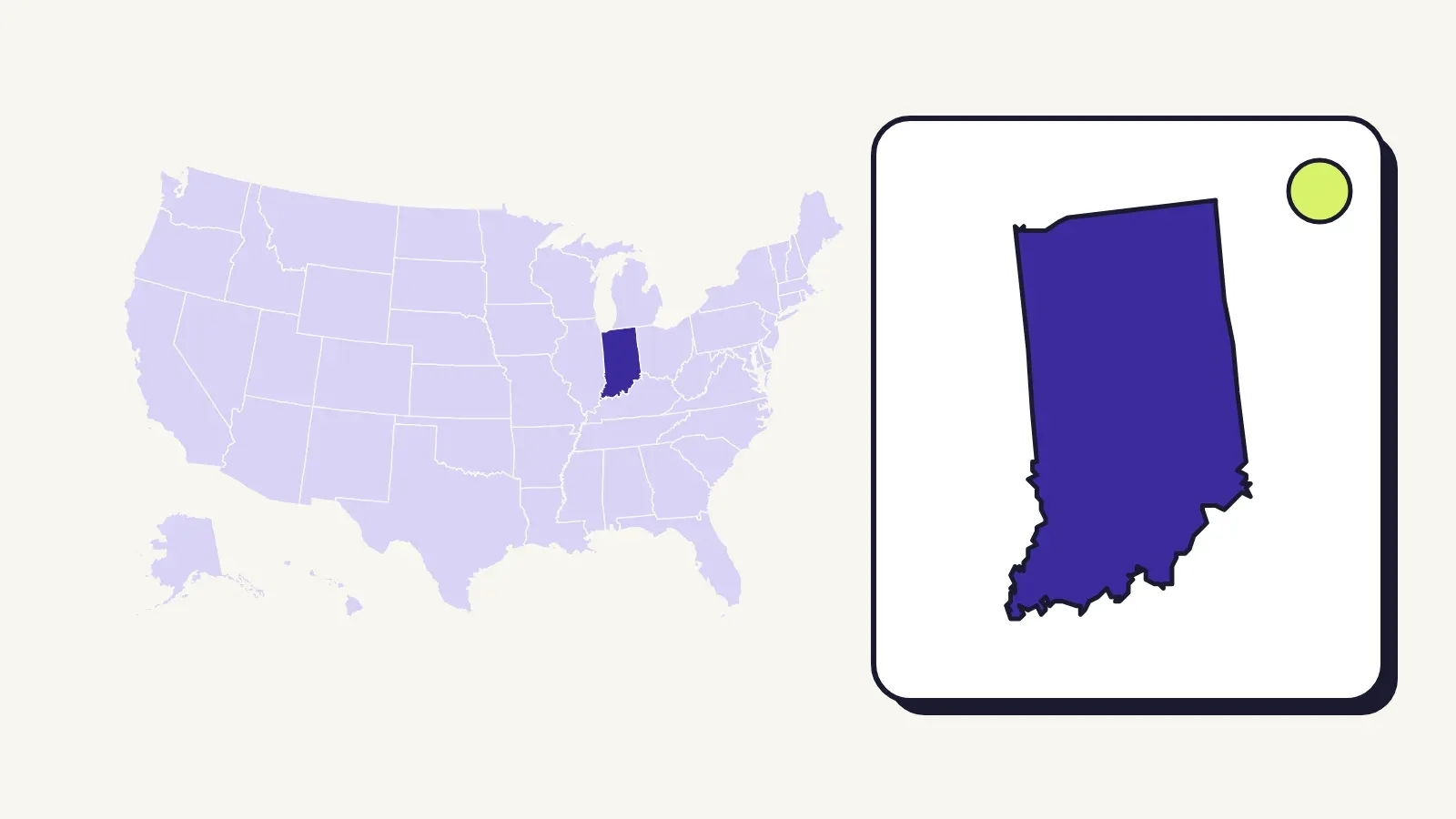
The short version
Indiana's small loan law allows payday-style loans of up to $825 outstanding with one lender, never more than 20% of your gross monthly income. The finance charge is capped at 15% of the first $250, 13% of the next $150 and 10% of the rest, for a term of at least 14 days, which is an APR of about 314% on an $825 two-week loan. Creditors generally have six years to sue, and garnishment is capped at 25% of disposable pay.
Indiana lending rules at a glance
How Indiana small loans are priced
Payday loans in Indiana are called small loans, and the lenders that make them are licensed by the Department of Financial Institutions (DFI). The finance charge is set in tiers:
| Amount borrowed | Maximum charge | APR over 14 days |
|---|---|---|
| $250 | $37.50 (15%) | About 391% |
| $400 | $57.00 (15% + 13%) | About 371% |
| $825 | $99.50 (15% + 13% + 10%) | About 314% |
The dollar charge is fixed by the tiers, so the APR depends on how long you keep the money. A loan must give you at least 14 days to repay. The only other fee the lender can add is a returned-check charge of up to $25, collected once.
Limits on how often you can borrow
- Two at most. A lender can't make you a loan if you already have two or more small loans outstanding.
- No renewals. A lender can't renew, refinance or consolidate your small loan with another one of its own.
- Consecutive loans count. A new loan within seven days of paying off the last one is consecutive.
- A free payment plan. At the third consecutive loan and after, the lender must offer an extended payment plan with no added fees. You can't take another small loan until it's paid off.
- A cooling-off period. After six loans in a row with one lender, you must wait seven days before borrowing again.
If you are taking out your third loan in a row, take the payment plan. Better still, look at payday loan alternatives before the first one.
Installment and title loans
Supervised lenders, the licensed finance companies that make larger installment loans, may charge the greater of two limits: tiered rates of 36% a year on the smallest balances, 21% on the middle tier and 15% above that, or a flat 25% a year. The tier boundaries started at $2,000 and $4,000 and are adjusted for inflation. On top of interest, a lender can charge a nonrefundable prepaid finance charge of up to $75, $150 or $200 depending on the loan amount, but not again on a refinance within three months, and no more than twice in 12 months.
Indiana's small loan law doesn't cover car title loans, so a loan secured by your car has to stay within the general consumer loan limits. Use the APR calculator to see what an installment offer really costs with fees included.
Debt time limits and garnishment
A creditor generally has six years to sue. That period applies to written contracts for the payment of money, such as loan agreements, and to accounts and unwritten contracts. Credit card debt falls under six years either way. See how statutes of limitations work before you pay on an old debt.
With a judgment, a creditor can garnish the lesser of 25% of your weekly disposable earnings or the amount above 30 times the federal minimum wage. If you show good cause, a court can lower the 25% limit, though not below 10%. Your employer can charge a processing fee, split between you and the creditor. For your rights with collectors, see debt collectors and your rights.
Complaints and license checks
- Look up the lender on DFI's license search before you apply, online or in a store.
- Check the math: the finance charge in dollars should match the tiers above for the amount you borrow.
- File a complaint with DFI by phone at (800) 382-4880, by email at dficomplaints@dfi.IN.gov or with its complaint form. You can also file with the CFPB.
Common questions
Are payday loans legal in Indiana?
Yes, as small loans from DFI-licensed lenders. You can owe up to $825 to one lender, and no more than 20% of your gross monthly income.
How much can an Indiana payday lender charge?
Up to 15% of the first $250, 13% of the amount from $250 to $400 and 10% of the amount from $400 to $825. On a two-week loan that is an APR above 300%.
What is the statute of limitations on debt in Indiana?
Generally six years for written contracts to pay money, accounts and credit card debt.
How much of my paycheck can be garnished in Indiana?
The lesser of 25% of disposable earnings or the amount above 30 times the federal minimum wage. A court can lower it to as little as 10% for good cause.
Sources
- Indiana Department of Financial Institutions — Indiana Small Loan Law brochure (2026)
- Indiana Department of Financial Institutions — Policies and guidance (IC 37 recodification)
- IC 24-4.5-3-508 — Supervised loan finance charges (Justia, 2025 Indiana Code)
- IC 34-11-2-9 — Written contracts for the payment of money (Justia)
- IC 34-11-2-7 — Accounts and unwritten contracts (Justia)
- IC 24-4.5-5-105 — Limitation on garnishment (Justia)
Facts on this page were checked against these sources on October 13, 2026. The APR figures are our own calculations from the statutory fee tiers for a 14-day loan.
Keep reading
-
Loan type
Payday loan alternatives
Credit union PALs up to $2,000 at 28% APR or less, paycheck advances, payment plans and local help.
-
Debt help
Old debt and time limits
Most states give collectors 3–6 years to sue. What can restart the clock, and why it's not the 7-year credit rule.
-
State law
Illinois
36% all-in APR cap on non-bank loans since 2021; loans above it are void. 10 years on written debts.